
Porsche has opened a microsite dedicated to the new 911 GT3 RS 4.0
New images have been published which also reveal the new RS in black.
The minisite provides more additional data than what was in the press release.
Enjoy the pictures and Click HERE to view the Microsite.
Click for Full Size


Friday, April 29, 2011


Thursday, April 28, 2011

When first revealed last December, the Audi R18 TDI broke the mold of more than ten years of open-cockpit, Audi Le Mans racers. There is more to the R18 than just its new, sinister design however. Thanks to revised regulations for the 2011 season, the Audi R18 boasts an all-new 3.7-liter, V6 TDI engine. Audi Sport has put together a detailed look at the new diesel, explaining everything you've ever wanted to know about Audi's latest Peugeot-pounding TDI.
Ingolstadt, April 28, 2011 – The new Audi R18 TDI with which Audi targets its tenth victory in the famous 24 Hours of Le Mans on June 11/12 is ready today with "tomorrow’s” technology. During development of the new LMP1 sports car the integration and future electrification of the powertrain and various possible concepts for energy recuperation have been taken into account.
"We are very conscious of such systems,” explains Head of Audi Motorsport Dr. Wolfgang Ullrich. "In our opinion, just as soon as this technology proves to be the most efficient we will use it at Le Mans.”
Although diesel engines have been repeatedly restricted by the regulations since their victorious introduction in 2006, Audi relies on TDI power once again for its new LMP1. "Audi invented the TDI engine and is convinced that this technology remains one of the most efficient and modern forms to power a car – especially at Le Mans where engines with high specific power, low fuel consumption and low emissions are a necessity.”
New regulations devised by the Automobile Club de L’Ouest (ACO) and introduced this year dictate significantly smaller engines. Audi has chosen a particularly compact 3.7 liter V6 TDI engine, which is about 25 per cent lighter than the V10 TDI power plant previously fitted to the older R15 TDI, and which leaves all options open for the technicians with regard to electrification and energy recuperation. "This would not be the case with a V8, for example, which is also permitted by the regulations,” explains Ulrich Baretzky, Head of Engine Development at Audi Sport.
However, Audi does not only surprise with its extremely compact engine. The concept is also innovative for an LMP1 sports car. To lower the center of gravity as much as possible and to improve airflow through the car, the exhaust manifolds were migrated from the left and right hand sides of the engine to sit between the two cylinder banks. "Hot side inside” is the name given to this concept by specialists, which was implemented in similar form in Formula 1 in the 1980s. But the V6 TDI engine powering the Audi R18 TDI, which has a cylinder angle of 120 degrees and thus an extremely low center of gravity, is technically generations further along the line and is also a technology-demonstrator for future production engines.

In contrast to previous Audi Le Mans sports cars, which all had twin turbochargers, the R18 TDI is quite logically now only fitted with a single turbocharger that also sits above the engine and draws its air directly through the air scoop mounted on the roof. "In this way we are able to convert the dynamic pressure generated at high speeds with minimal losses into power,” explains Dr. Martin Mühlmeier, Head of Technology at Audi Sport.
The mono-turbo concept developed in cooperation with Garrett was only made possible by the variable turbine geometry (VTG) already used victoriously in the R15 TDI. "Otherwise the response characteristics of such a large turbocharger would just be too bad,” explains Baretzky.
The concept was continued logically through a single pipe exhaust that exits at the rear of the R18 TDI below the new fin which is stipulated by the regulations. "This also stands for Audi ultra lightweight technology,” says Baretzky, "since we save components and weight – for example for a second diesel particle filter.”
Audi Sport has worked since July 2009 on the innovative engine concept for which numerous new routes had to be explored. To control the enormous ignition pressures and loads now only distributed between six cylinders, a unique method of cooling the cylinder heads was developed for the aluminum power unit, a concept that could also be interesting in the future for production.

Owing to the compact engine and uncluttered flanks, the airflow from the coolers can now exit practically unobstructed through the rear end. "We could increase the aerodynamic efficiency of the car as a result,” says Martin Mühlmeier, Head of Technology at Audi Sport. This aspect is even more important than ever before at Le Mans due to the reduction in engine power – for the Audi R18 TDI more than 397 kW (540 hp).
Another unique aspect of the new Le Mans sports car is its unusual sound. The Audi R18 TDI is probably the quietest race car Audi Sport has ever built. "Noise is unused energy,” stresses Dr. Wolfgang Ullrich who is delighted by the whispering murmur of the R18 TDI. "The sound is unique,” raves Le Mans record winner Tom Kristensen. "It’s hard to describe. You have to hear it yourself. I think it’s fantastic.”
Listen for yourself!
Click title for the source
Porsche has made it official - this is the 911 GT3 RS 4.0.
It will be a limited edition of just 600 units and power will come from a naturally-aspirated 4.0 liter engine sourced from the race-bred 911 GT3 RSR. The 4.0 liter is the biggest engine ever offered in a Porsche which translates into a hp/liter figure around - 125 hp/liter (92 kW) and 368 hp/tonne.
That makes for a total output of 500 PS (368 kW / 493 hp) but now we have a torque rating from Porsche of 460 Nm (339 lb-ft). Transmission will be a six-speed sport gearbox.
Weighing just 1,360 kilograms (2998 lbs) the car does the 0 to 100 km/h (62 mph) sprint in only 3.9 seconds and the GT3 RS 4.0 rounds the Nürburgring-Nordschleife in 7:27 minutes.
The Porsche 911 GT3 RS 4.0 goes on sale in Germany and UK in July with prices starting at €178,596, VAT and the £128,466 respectively.
Click for Full Size


Click title for the source


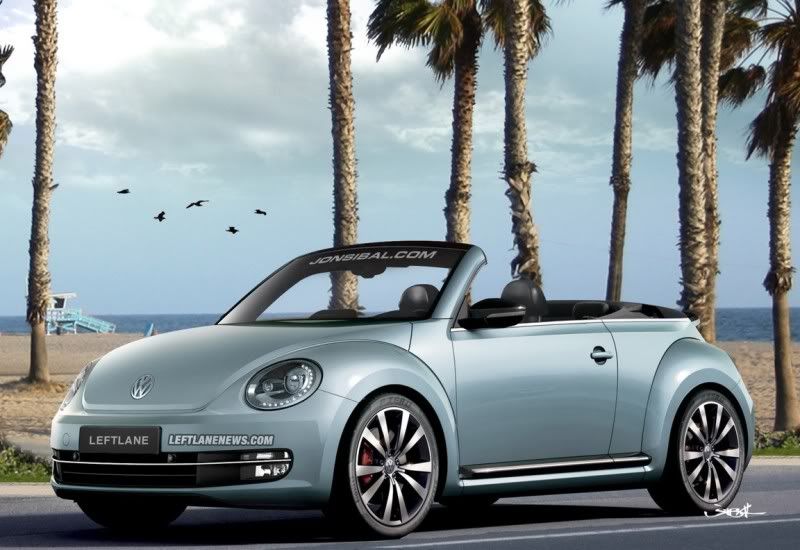
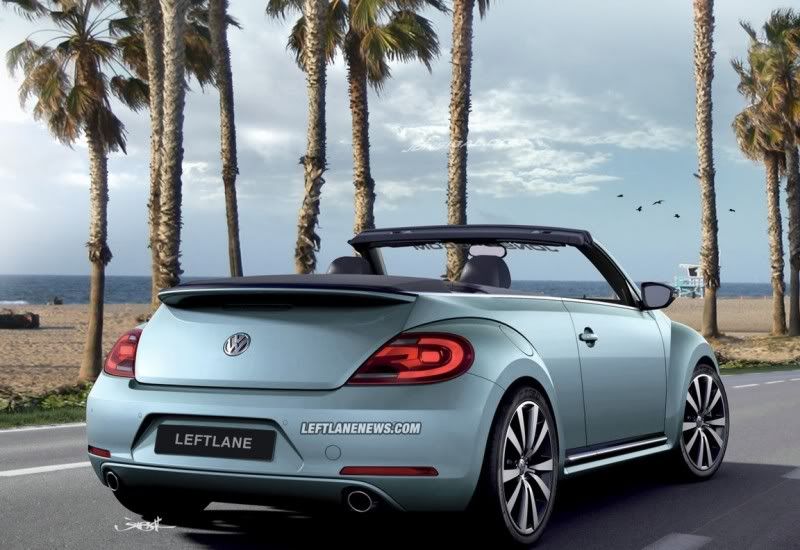
Although the all-new 2013 Volkswagen Beetle’s most notable change might be its lowered roof line, the German automaker is set to change things even further when it releases a Cabriolet version later this year.
Expected to debut at the 2011 Frankfurt Motor Show in September, the 2013 Volkswagen Beetle Cabriolet will be offered worldwide as an alternative to the fixed roof example. A droptop version of the outgoing New Beetle (which wasn’t so new at the time) debuted for 2003, five years after the coupe model. Despite the wait, it proved tremendously popular, quickly changing the New Beetle’s image to that of a fun-loving beach cruiser.
The wait won’t be quite as long for the second-generation reborn Beetle, which loses its “new” nomenclature. A quick-stowing, fully insulated power top will be standard. Likely to not require any manual latching, it will hide away behind the rear seats to take up as little room as possible. A heated glass rear window will also be standard.
Otherwise, the Beetle Cabriolet will essentially mirror its hardtop sibling. Only two powertrains are expected to be offered in the droptop variant – the hardtop’s available TDI diesel unit won’t make the cut.
That means that retro-minded sun worshippers will have to choose between a 170 horsepower five-cylinder or a 201-pony turbocharged four. Both six-speed manual and six-speed automatic transmissions will be on offer, although the base model may not be available with the row-it-yourself unit.
Globally, the Beetle Cabriolet will serve as a more style-oriented sibling to the new Golf Cabriolet, although North American buyers will probably only get one droptop.
Pricing won’t be announced until closer to the Spring 2012 on-sale date, but the droptop should net about a 7-10 percent premium.
Click title for the source

The next iteration of the 911 series, codenamed 991, isn’t the only new model undergoing development by Porsche these days. The Stuttgart-based sports car maker is also busy testing a brand new generation of the Boxster, as these latest spy photos reveal.
In typical Porsche fashion, the third generation Boxster’s styling will be an evolution of the second generation model, which itself was an...evolution of the original drop-top, entry-level Porsche which debuted in 1996.
However, expect to see some styling influences from the Panamera at both ends of the car, as well as in the cabin. As you can see from the scoop pictures, the prototype model keeps the current version’s electrically operated cloth top.
Despite the evolutionary design, it’s all new under the skin as the 2012 Boxster will ride on a modified version of the new chassis underpinning the upcoming 991. Its wheelbase and overall length will both grow and as a result, improve passenger and luggage space. The larger dimensions will not lead to an increase in weight, with the new Boxster is expected to be marginally lighter than the current model.
The engine range will include a newer version of Porsche’s flat-six in both the standard and S models with improved performance as well as fuel economy figures, but we’ve also heard that the German company is developing a new turbocharged four-cylinder engine that will eventually be offered in both the next Boxter and the Cayman's replacement.
It remains to be seen if Porsche will choose the Frankfurt Motor Show in September or, as some sources suggest, the 2012 Detroit Motor Show next January for the world premiere of the third generation Boxster model. 
Click for Full Size

Click title for the source


